
What Is AI and ML? A Complete Beginner Guide to Starting a Career in AI and ML
Did you know? Gartner projects global AI spending to hit $2.5 trillion in 2026, which means AI/ML talent is in high demand right now. If you’re a final year student, fresher or early career professional (even from a non‑coding background) looking to start in AI/ML this guide is for you. And if you’re a working professional in Pune, Maharashtra India planning to upskill or reskill you’ll find a clear beginner friendly roadmap here. Artificial Intelligence (AI) and Machine Learning (ML) are everywhere today from the apps we use daily to the systems that power businesses, banks, hospitals and even social media. With AI adoption growing rapidly in India especially in tech hubs like Pune, Mumbai and Hyderabad etc. thousands of students, fresh graduates and working professionals are now looking to start a career in this exciting field. This blog will help you understand AI, ML, how they differ, who can learn them, career paths and how you can begin your journey easily even if you are from a non‑coding background.
What is AI?
Artificial Intelligence (AI) is the technology that helps computers act smart like recognizing your face, understanding your voice, suggesting movies or detecting spam. AI systems learn from data and make decisions the way humans do but much faster. From recommendation systems to fraud detection and smart assistants, AI powers many products we use every day.
Did you know? India’s AI market expected to grow at around ~25% CAGR through 2027 and companies actively adopting AI and investing in skill development, career opportunities in AI and ML are rising quickly nationwide.
In simple terms, AI helps machines:
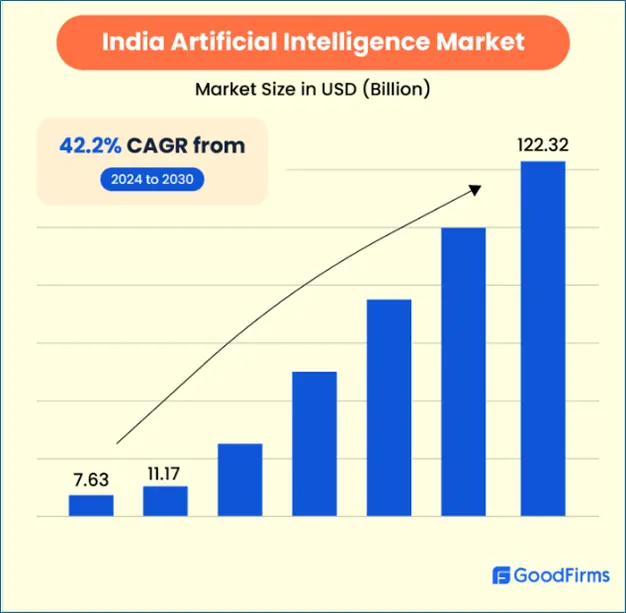
Source: www.goodfirms.co
- Understand data
- Make decisions
- Solve problems
- Recognize images, speech or patterns
- Learn from experience
Examples of AI around you:
- Google Maps predicting traffic
- Netflix recommending movies
- Chatbots answering your questions
- Face unlocks on your phone
What is ML?
Machine Learning (ML) is a subset of Artificial Intelligence (AI) that allows computers to learn from data, find patterns, and improve their performance over time without being explicitly programmed. Instead of following fixed rules, ML models use algorithms to analyse data and make predictions, classifications or decisions.
- Supervised learning: The model learns from examples that come with labels for instance, messages marked as “spam” or “not spam”.
- Unsupervised learning: Find structure in unlabelled data (e.g., customer segments).
- Reinforcement learning: Learn via trial and error (e.g., robots navigating).
Did you know? AI/ML roles in India surged ~25 - 42% year‑on‑year in 2025, even as some traditional IT roles slowed underscoring sustained demand for ML skills.
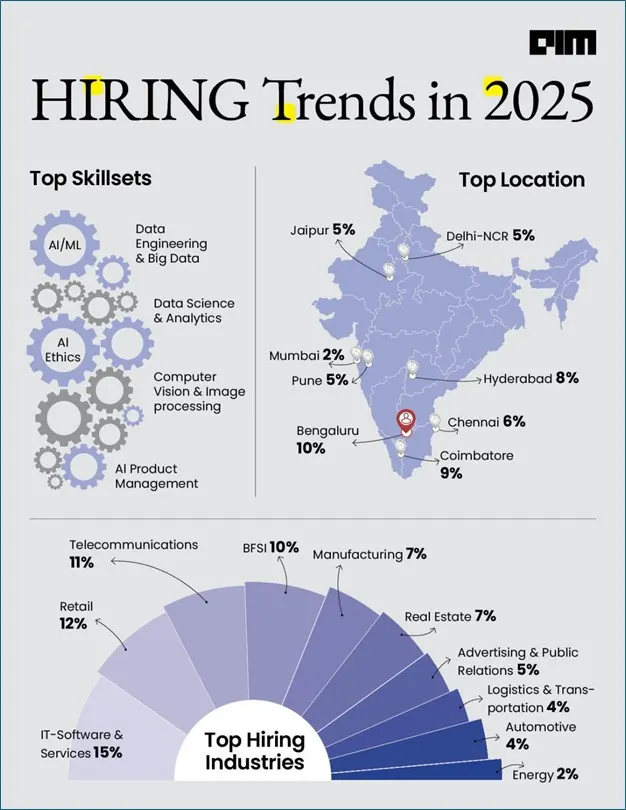
Source: www.linkedin.com or AIM
Instead of teaching the computer every rule, we give it examples and it learns patterns on its own.
Examples:
- Spam email detection
- Predicting weather
- Alexa or Siri understanding your voice
- Online shopping recommendations
Difference Between AI and ML
| AI (Artificial Intelligence) | ML (Machine Learning) |
|---|---|
| AI is the broader concept of creating smart machines. | ML is a subset of AI. |
| Focuses on decision making and problem solving. | Focuses on learning from data. |
| Example: Self-driving car. | Example: Car learning road signs from images. |
Simple Explanation: AI is the bigger concept of making machines smart, and ML is the method that helps them learn.
Kickstart Your AI and ML Career: A Beginner’s Simple Guide
You can start your AI/ML journey step by step:
1. Begin with Basics
- Learn Python (beginner‑friendly and widely used in AI/ML)
- Understand basic math: statistics, probability, linear algebra
2. Learn Core Concepts
- Machine learning algorithms
- Data preprocessing
- Model training and evaluation
- Neural networks (for deep learning)
3. Work on Projects
Build small, real life projects like:
- Movie recommendation system
- Spam message classifier
- Sales prediction model
Projects help you build confidence and strengthen your resume.
4. Learn Tools and Technologies
- Python libraries: NumPy, pandas, scikit‑learn
- Deep learning: TensorFlow or PyTorch
- Cloud tools: AWS, Azure, Google Cloud
- Visualization tools: Power BI, Tableau
5. Create a Portfolio
Add your projects to:
- GitHub
- Online resume
6. Apply for Internships or Training Programs
Hands-on experience is extremely important
Beginner → Python Basics → ML Fundamentals → Deep Learning → Deployment → Internship/Projects → Job Roles
Who Can Learn AI or ML?
The best part anyone can learn AI/ML.
Suitable for:
- Final year students
- Fresh graduates (any stream)
- IT and non‑IT professionals
- People looking to upskill or switch careers
- Individuals curious about technology and problem solving
You don’t need to be a coding or math genius to begin.
Can Non-Coding Students Become AI or ML Experts?
Yes, absolutely!
Many successful AI/ML professionals started with zero coding background.
How non‑coders can begin:
- Start with beginner friendly Python
- Learn through visual tools and simple projects
- Build step by step from basics to advanced concepts
- Join guided programs that include hands on practice
- Focus on understanding concepts, not memorizing formulas
With proper training, guidance and practice, non-coding students can become AI/ML engineers, analysts or specialists.
AI and ML Job Roles and High Demand
AI and ML are among the top in-demand careers in India and globally.
Popular job roles:
- Machine Learning Engineer
- AI Engineer
- Data Scientist
- Data Analyst
- Deep Learning Engineer
- NLP Engineer
- Business Analyst (AI/ML-focused)
- AI Research Assistant
Industries hiring AI/ML talent:
- IT and Software
- Banking and Finance
- Healthcare
- Retail and E-commerce
- Manufacturing
- Cybersecurity
- EdTech
- Automotive
AI/ML jobs offer excellent salaries, career growth and future stability, making them one of the most rewarding career choices today.
AI and ML Salary Range and Career Growth (India)
Here’s a simple, clear salary table to help students understand the industry growth:
| Role | Fresher Salary Range | Mid-Level | Senior-Level |
|---|---|---|---|
| ML Engineer | ₹4–6 LPA | ₹8–10 LPA | ₹13–20+ LPA |
| Data Scientist | ₹7–10 LPA | ₹15–22 LPA | ₹25–40 LPA |
| AI Engineer | ₹6–9 LPA | ₹12–20 LPA | ₹18–30 LPA |
These numbers vary based on skills, city, company type and portfolio strength but overall, AI/ML roles offer excellent growth.
Real-World Examples of AI in India
AI is not just a future concept it’s already being used across India. Here are some examples:
1. AI in Indian Banking
Banks across India are using AI and ML to:
- Detect fraudulent transactions in real-time
- Analyse customer spending patterns
- Predict credit risk before giving loans
- Automate customer support through chatbots
This helps banks reduce fraud, approve loans faster and provide safer banking services.
2. AI in Automotive and Manufacturing Industry
In automotive and manufacturing hub companies use AI for:
- Predictive maintenance to avoid machine breakdowns
- Quality inspection using computer vision
- Robotics automation in assembly lines
- Inventory and supply chain optimization
This improves productivity and reduces downtime.
3. AI in Healthcare
India’s healthcare sector uses AI to:
- Assist in early diagnosis of diseases
- Analyse X-rays, CT scans and MRIs faster
- Automate medical report generation
- Predict patient risks (like diabetes, heart issues)
Hospitals in Pune increasingly use AI tools to improve patient care and reduce waiting times.
4. AI in Retail and E-commerce
Your favourite shopping apps use AI for:
- Personalized product recommendations
- Predicting sales trends
- Dynamic pricing
- Customer sentiment analysis
This is why your online stores feel “smart” and know what you like.
Mistakes to Avoid in AI and ML
Many students or beginners lose motivation because they unknowingly follow the wrong approach. Here are the biggest mistakes and how to avoid them:
- Watching Too Many Tutorials (Not Building Anything)
Learning only through videos doesn’t build real skills. Projects do. - Focusing Only on Theory
You don’t need to memorize formulas. You just need practical understanding. - Ignoring GitHub
Recruiters check portfolios. A clean GitHub profile is a huge advantage. - Not Deploying Models
Even a simple deployed project can instantly put you apart from 90% of learners. - Jumping Straight to Deep Learning
Start with basics: Python → ML fundamentals → then Deep Learning.
Skipping steps = confusion + burnout.
3 Sample Beginner Projects (Step-by-Step)
These simple projects help you build confidence and strong fundamentals.
1. Spam Message Classifier (Easy ML Classification Project)
Steps:
- Collect SMS/email dataset
- Clean and preprocess text
- Convert text to numerical features
- Train a classification model (Naive Bayes / Logistic Regression)
- Test and deploy with Streamlit
Perfect for learning NLP basics.
2. House Price Prediction (Regression Project)
Steps:
- Use a dataset with house prices
- Understand features like size, location, rooms
- Train a regression model
- Evaluate with RMSE
- Deploy a small prediction web app
Great beginner friendly introduction to ML.
3. Sentiment Analysis on Reviews (NLP Project)
Steps:
- Use product or movie reviews
- Clean text and remove noise
- Train a sentiment classifier
- Predict “Positive/Negative/Neutral”
- Deploy and visualize with a dashboard
Very impressive for portfolios.
AI and ML Skill Checklist (Beginner Friendly)
Here’s a quick checklist for students or beginners:
- Basic Python
- Statistics and Probability
- Machine Learning Algorithms
- Deep Learning Fundamentals
- SQL
- Cloud Basics (AWS/Azure/GCP)
- GitHub Portfolio
- 2 or 3 Real World Projects
- Understanding Problem Statements
- Basic Data Visualization (Matplotlib/Seaborn/Power BI)
How Long Does It Take to Learn AI/ML?
Every learner is different — lifestyle, background and study pace matter. Here’s an empathetic guide for all types of students:
- Fast-Track Path (2–3 Months)
Perfect for full-time learners.
Focus: Python, ML algorithms, 3 or 4 projects, basics of deployment. - Balanced Path (3–6 Months)
Ideal for college students.
Focus: ML + Deep Learning + 4 or 5 projects + GitHub portfolio. - Slow-Paced Path (6–9 Months)
Best for working professionals.
Focus: Flexible weekend learning, cloud basics, deployment and a strong capstone project.
This helps readers choose a pace that fits their schedule without pressure.
About Futurism Xpro
If you want to start your career in AI/ML with hands-on training, real projects and placement assistance, Futurism Xpro offers one of the most comprehensive training program in Pune.
At Futurism Xpro, you get:
- Practical AI/ML training
- Onsite internship
- Training by global industry experts
- Real-world projects and corporate environment
- 100% placement assistance
- Guidance for resume, interviews and portfolio building
Whether you're a fresher, student or working professional, Futurism Xpro helps you become job ready in today’s competitive AI/ML world.
Conclusion
AI and ML are transforming the world and this is the perfect time to start your journey. Whether you’re from a technical or non-technical background you can build a successful career with the right learning path, hands-on projects and guidance.
If you're ready to begin your AI/ML career with expert-led training and real-world experience, explore Futurism Xpro —your partner in shaping a future-proof tech career.
Start your AI and ML journey with Futurism Xpro today.
Visit: www.futurismxpro.com